 Add to Chrome
 Add to Firefox
 Add to Edge
Planning with the Views via Scene Self-Exploration
May 28, 2026
Can VLMs predict how each camera move changes the view, and plan many such moves ahead? We call this capability view planning, requiring (1)understanding how a single action transforms the view, and (2)composing many such transformations across multi-turn plans to identify a target view. We probe both abilities in our proposed ViewSuite, a 3D point-cloud environment on real ScanNet scenes. Across 13 frontier VLMs, a critical planning gap emerges: they possess basic view-action knowledge but fail to compose it across multi-turn plans, with the gap widening as viewpoint distance grows. To close this gap, we propose an iterative framework that alternates self-exploration with view graph distillation. The key insight is that all exploration trajectories, regardless of their outcome, collectively form a view graph that compactly captures how viewpoints connect across a scene. Distilling this graph into diverse supervised tasks reshapes the policy distribution and overcomes the sparse rewards that stall pure RL. This improves Qwen2.5-VL-7B from 2.5% to 47.8% on interactive view planning, surpassing GPT-5.4 Pro (18.5%) and Gemini 3.1 Pro (21.4%). Self-exploration emerges as a promising path toward VLMs that can actively reason and plan in 3D space.

Scalable, Energy-Efficient Optical-Neural Architecture for Multiplexed Deepfake Video Detection
May 19, 2026The rapid proliferation of AI-generated visual media has created an urgent need for efficient, trustworthy deepfake detection systems. However, existing deep learning-based detection methods rely on computationally intensive and energy-demanding inference algorithms, limiting their scalability. Here, we present a hybrid digital-analog deepfake video detection framework that combines a lightweight digital front-end with a spatially multiplexed optical decoding back-end for massively parallel analog inference through a programmable spatial light modulator. By simultaneously processing 15 or more video streams within a single optical propagation pass, the system enables high-throughput and accurate video-level authenticity prediction at reduced computational cost compared with purely digital methods. We validated this hybrid deepfake video processor using different datasets spanning classical face-swapping, real-world deepfake recordings, and fully AI-generated videos. Using a spatially multiplexed experimental set-up operating in the visible spectrum, we achieved average deepfake detection accuracy, sensitivity and specificity of 97.79%, 99.86% and 95.72%, respectively, on the Celeb-DF video dataset with 15 videos tested in parallel in a single optical pass per inference. The multiplexed optical decoder also demonstrates resilience against various types of video degradation, noise, compression, experimental misalignments and black-box adversarial attacks. Our results show that integrating optical computation into AI inference enables simultaneous gains in throughput, energy efficiency, and adversarial robustness - three properties that are difficult to achieve together in purely digital systems.
RAGEN-2: Reasoning Collapse in Agentic RL
Apr 07, 2026RL training of multi-turn LLM agents is inherently unstable, and reasoning quality directly determines task performance. Entropy is widely used to track reasoning stability. However, entropy only measures diversity within the same input, and cannot tell whether reasoning actually responds to different inputs. In RAGEN-2, we find that even with stable entropy, models can rely on fixed templates that look diverse but are input-agnostic. We call this template collapse, a failure mode invisible to entropy and all existing metrics. To diagnose this failure, we decompose reasoning quality into within-input diversity (Entropy) and cross-input distinguishability (Mutual Information, MI), and introduce a family of mutual information proxies for online diagnosis. Across diverse tasks, mutual information correlates with final performance much more strongly than entropy, making it a more reliable proxy for reasoning quality. We further explain template collapse with a signal-to-noise ratio (SNR) mechanism. Low reward variance weakens task gradients, letting regularization terms dominate and erase cross-input reasoning differences. To address this, we propose SNR-Aware Filtering to select high-signal prompts per iteration using reward variance as a lightweight proxy. Across planning, math reasoning, web navigation, and code execution, the method consistently improves both input dependence and task performance.
Compressive single-pixel imaging via a wavelength-multiplexed spatially incoherent diffractive optical processor
Mar 23, 2026Despite offering high sensitivity, a high signal-to-noise ratio, and a broad spectral range, single-pixel imaging (SPI) is limited by low measurement efficiency and long data-acquisition times. To address this, we propose a wavelength-multiplexed, spatially incoherent diffractive optical processor combined with a compact/shallow digital artificial neural network (ANN) to implement compressive SPI. Specifically, we model the bucket detection process in conventional SPI as a linear intensity transformation with spatially and spectrally varying point-spread functions. This transformation matrix is treated as a learnable parameter and jointly optimized with a shallow digital ANN composed of 2 hidden nonlinear layers. The wavelength-multiplexed diffractive processor is then configured via data-free optimization to approximate this pre-trained transformation matrix; after this optimization, the diffractive processor remains static/fixed. Upon multi-wavelength illumination and diffractive modulation, the target spatial information of the input object is spectrally encoded. A single-pixel detector captures the output spectral power at each illumination band, which is then rapidly decoded by the jointly trained digital ANN to reconstruct the input image. In addition to our numerical analyses demonstrating the feasibility of this approach, we experimentally validated its proof-of-concept using an array of light-emitting diodes (LEDs). Overall, this work demonstrates a computational imaging framework for compressive SPI that can be useful in applications such as biomedical imaging, autonomous devices, and remote sensing.
SAIF: A Stability-Aware Inference Framework for Medical Image Segmentation with Segment Anything Model
Mar 13, 2026Segment Anything Model (SAM) enable scalable medical image segmentation but suffer from inference-time instability when deployed as a frozen backbone. In practice, bounding-box prompts often contain localization errors, and fixed threshold binarization introduces additional decision uncertainty. These factors jointly cause high prediction variance, especially near object boundaries, degrading reliability. We propose the Stability-Aware Inference Framework (SAIF), a training-free and plug-and-play inference framework that improves robustness by explicitly modeling prompt and threshold uncertainty. SAIF constructs a joint uncertainty space via structured box perturbations and threshold variations, evaluates each hypothesis using decision stability and boundary consistency, and introduces a stability-consistency score to filter unstable candidates and perform stability-weighted fusion in probability space. Experiments on Synapse, CVC-ClinicDB, Kvasir-SEG, and CVC-300 demonstrate that SAIF consistently improves segmentation accuracy and robustness, achieving state-of-the-art performance without retraining or architectural modification. Our anonymous code is released at https://anonymous.4open.science/r/SAIF.
SkillCraft: Can LLM Agents Learn to Use Tools Skillfully?
Feb 28, 2026Real-world tool-using agents operate over long-horizon workflows with recurring structure and diverse demands, where effective behavior requires not only invoking atomic tools but also abstracting, and reusing higher-level tool compositions. However, existing benchmarks mainly measure instance-level success under static tool sets, offering limited insight into agents' ability to acquire such reusable skills. We address this gap by introducing SkillCraft, a benchmark explicitly stress-test agent ability to form and reuse higher-level tool compositions, where we call Skills. SkillCraft features realistic, highly compositional tool-use scenarios with difficulty scaled along both quantitative and structural dimensions, designed to elicit skill abstraction and cross-task reuse. We further propose a lightweight evaluation protocol that enables agents to auto-compose atomic tools into executable Skills, cache and reuse them inside and across tasks, thereby improving efficiency while accumulating a persistent library of reusable skills. Evaluating state-of-the-art agents on SkillCraft, we observe substantial efficiency gains, with token usage reduced by up to 80% by skill saving and reuse. Moreover, success rate strongly correlates with tool composition ability at test time, underscoring compositional skill acquisition as a core capability.
Snapshot 3D image projection using a diffractive decoder
Dec 23, 20253D image display is essential for next-generation volumetric imaging; however, dense depth multiplexing for 3D image projection remains challenging because diffraction-induced cross-talk rapidly increases as the axial image planes get closer. Here, we introduce a 3D display system comprising a digital encoder and a diffractive optical decoder, which simultaneously projects different images onto multiple target axial planes with high axial resolution. By leveraging multi-layer diffractive wavefront decoding and deep learning-based end-to-end optimization, the system achieves high-fidelity depth-resolved 3D image projection in a snapshot, enabling axial plane separations on the order of a wavelength. The digital encoder leverages a Fourier encoder network to capture multi-scale spatial and frequency-domain features from input images, integrates axial position encoding, and generates a unified phase representation that simultaneously encodes all images to be axially projected in a single snapshot through a jointly-optimized diffractive decoder. We characterized the impact of diffractive decoder depth, output diffraction efficiency, spatial light modulator resolution, and axial encoding density, revealing trade-offs that govern axial separation and 3D image projection quality. We further demonstrated the capability to display volumetric images containing 28 axial slices, as well as the ability to dynamically reconfigure the axial locations of the image planes, performed on demand. Finally, we experimentally validated the presented approach, demonstrating close agreement between the measured results and the target images. These results establish the diffractive 3D display system as a compact and scalable framework for depth-resolved snapshot 3D image projection, with potential applications in holographic displays, AR/VR interfaces, and volumetric optical computing.
SynLogic: Synthesizing Verifiable Reasoning Data at Scale for Learning Logical Reasoning and Beyond
May 26, 2025Recent advances such as OpenAI-o1 and DeepSeek R1 have demonstrated the potential of Reinforcement Learning (RL) to enhance reasoning abilities in Large Language Models (LLMs). While open-source replication efforts have primarily focused on mathematical and coding domains, methods and resources for developing general reasoning capabilities remain underexplored. This gap is partly due to the challenge of collecting diverse and verifiable reasoning data suitable for RL. We hypothesize that logical reasoning is critical for developing general reasoning capabilities, as logic forms a fundamental building block of reasoning. In this work, we present SynLogic, a data synthesis framework and dataset that generates diverse logical reasoning data at scale, encompassing 35 diverse logical reasoning tasks. The SynLogic approach enables controlled synthesis of data with adjustable difficulty and quantity. Importantly, all examples can be verified by simple rules, making them ideally suited for RL with verifiable rewards. In our experiments, we validate the effectiveness of RL training on the SynLogic dataset based on 7B and 32B models. SynLogic leads to state-of-the-art logical reasoning performance among open-source datasets, surpassing DeepSeek-R1-Distill-Qwen-32B by 6 points on BBEH. Furthermore, mixing SynLogic data with mathematical and coding tasks improves the training efficiency of these domains and significantly enhances reasoning generalization. Notably, our mixed training model outperforms DeepSeek-R1-Zero-Qwen-32B across multiple benchmarks. These findings position SynLogic as a valuable resource for advancing the broader reasoning capabilities of LLMs. We open-source both the data synthesis pipeline and the SynLogic dataset at https://github.com/MiniMax-AI/SynLogic.
Bring Reason to Vision: Understanding Perception and Reasoning through Model Merging
May 08, 2025Vision-Language Models (VLMs) combine visual perception with the general capabilities, such as reasoning, of Large Language Models (LLMs). However, the mechanisms by which these two abilities can be combined and contribute remain poorly understood. In this work, we explore to compose perception and reasoning through model merging that connects parameters of different models. Unlike previous works that often focus on merging models of the same kind, we propose merging models across modalities, enabling the incorporation of the reasoning capabilities of LLMs into VLMs. Through extensive experiments, we demonstrate that model merging offers a successful pathway to transfer reasoning abilities from LLMs to VLMs in a training-free manner. Moreover, we utilize the merged models to understand the internal mechanism of perception and reasoning and how merging affects it. We find that perception capabilities are predominantly encoded in the early layers of the model, whereas reasoning is largely facilitated by the middle-to-late layers. After merging, we observe that all layers begin to contribute to reasoning, whereas the distribution of perception abilities across layers remains largely unchanged. These observations shed light on the potential of model merging as a tool for multimodal integration and interpretation.
SkyLadder: Better and Faster Pretraining via Context Window Scheduling
Mar 19, 2025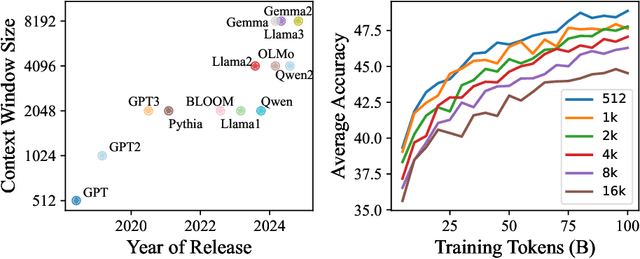

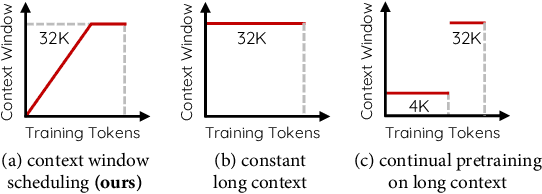
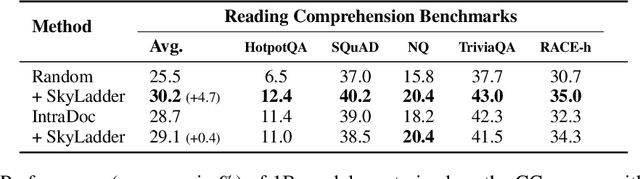
Recent advancements in LLM pretraining have featured ever-expanding context windows to process longer sequences. However, our pilot study reveals that models pretrained with shorter context windows consistently outperform their long-context counterparts under a fixed token budget. This finding motivates us to explore an optimal context window scheduling strategy to better balance long-context capability with pretraining efficiency. To this end, we propose SkyLadder, a simple yet effective approach that implements a short-to-long context window transition. SkyLadder preserves strong standard benchmark performance, while matching or exceeding baseline results on long context tasks. Through extensive experiments, we pre-train 1B-parameter models (up to 32K context) and 3B-parameter models (8K context) on 100B tokens, demonstrating that SkyLadder yields consistent gains of up to 3.7% on common benchmarks, while achieving up to 22% faster training speeds compared to baselines. The code is at https://github.com/sail-sg/SkyLadder.